By Kaylee Alivo
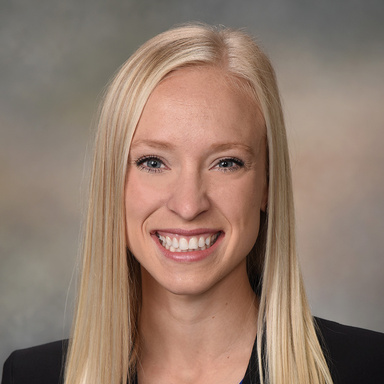
Ericka (Tank) Muhlbauer, MD (B.S. ’14), is a family medicine physician in Carroll, Iowa, where she cares for patients at McFarland Clinic and St. Anthony Regional Hospital. Long before she was delivering babies and supporting families in western Iowa, her path began at the University of Iowa’s Department of Health, Sport, and Human Physiology (HSHP). As a human physiology major in the College of Liberal Arts and Sciences, Muhlbauer built a science foundation, found mentors, and gained hands-on research experience that helped her prepare for medical school and continues to shape the way she practices medicine today.
Finding the right fit in Human Physiology
When Muhlbauer arrived at Iowa, she already knew she wanted to become a doctor. The question was which major would give her the best foundation for that path.
“I still remember thumbing through the brochures of the different science majors I had gotten at my University of Iowa visit day,” she said. “When I came across the Human Physiology brochure, I remember thinking, ‘This is perfect!’”
Human physiology combined the science and math she loved with a clear connection to patient care.
“Human physiology sort of combined all of the branches of science and math I would need to allow me to better understand how the body worked,” she said. “I felt that this knowledge base would allow me to investigate the root cause of a patient’s symptoms in order to come to the correct diagnosis, treatment, and future prevention of disease.”
The major also covered nearly all of her pre-med requirements and aligned directly with her goal of attending medical school.
Relevant and applicable coursework
Early in the program, Muhlbauer saw how her classes connected to the kind of work she hoped to do.
“I just really enjoyed all of my classes and the faculty,” she said. “The coursework was all so applicable to my career aspiration of becoming a doctor, and I could see daily how it would translate to medical school and caring for patients.”
She still thinks about specific Health, Sport, and Human Physiology courses when she meets with patients.
“Cardiovascular Physiology with Associate Professor Emeritus Harald Stauss was by far the most difficult class,” she said. “But I still remember specific diagrams he drew and how he explained certain things when I am teaching patients about hypertension and heart failure.”
She also points to other courses that felt especially connected to real-world health and medicine.
“Human Physiology with [Associate Professor of instruction] Clay Peterson and Exercise Physiology with Professor [and Chair of HSHP] Gary Pierce both seemed very translational to medicine and health in general, and I use concepts from these classes daily,” she said.
By the time she started at the Carver College of Medicine, she felt ready.
“I truly feel I was as prepared as any of my peers and as prepared for medical school as one could be,” she said.
Confidence built by mentors and research
Faculty mentorship helped Muhlbauer turn classroom learning into a clear path forward. She calls Pierce “an influential mentor” who took a chance on her when she had little research experience and then invested time in helping her find her niche.
“I really had no research [experience] when I started working in his lab, so I felt like he had really taken a chance when he hired me,” she said. “He invested quality energy and time into his students and helped them find their ‘niche.’I truly believe the opportunities I received from studying and doing research with the Pierce Lab played a significant part in my path to medical school.” path to medical school.”
Working in Pierce’s lab gave her experience across the research process–from hypothesis development and journal club to data analysis and presentations–often while interacting directly with patients.
“I assisted with all aspects of scientific research,” she said. “Performing both clinical studies as well as more traditional bench research, statistical analysis and interpretation of data, writing a manuscript, and presenting research via poster and oral presentations.” Those experiences, she added, “have been instrumental in understanding evidence-based medicine, screening tests, prevention, treatments, and ultimately, providing the best patient care I am able to.”
Beyond research and coursework, some of the most impactful lessons she carried forward were about balance and sustainability in a demanding field. She also found lasting guidance from Peterson’s perspective on what it means to care for others while still protecting your own energy.
“I still have an email printed off and tacked to the bulletin board in my office, almost 15 years later, with advice he gave me during undergrad,” she said. “He basically acknowledged the importance of helping others but also stressed the importance of conserving some of my energy to myself to ensure it would be sustainable.”
At a time when she felt constant pressure to say yes to every opportunity to build her resume for medical school, hearing a professor tell her it was okay, and necessary, to set boundaries stood out.
“There seemed to be so much pressure from advisors and upper classmen to ‘build your resume’ and to always ‘do more’ if you wanted to have a chance to get into medical school,” she said. “I had never really had a professor tell me it was okay and necessary to say ‘no’ once in a while.”
Giving back to the department that started it all
Today, Muhlbauer remains closely connected to the Department of Health, Sport, and Human Physiology through her service on the HSHP Advisory Board. She sees it as an opportunity to give back to the program that shaped her.
“I truly believe my career and the trajectory my life took starting on day one of my freshman year were initiated by my education, the faculty, and the opportunities my undergraduate experience in HSHP provided me,” she said. “I am honored to be able to try to give back to this department, as it is the reason I am doing what I love today.”
For current HSHP students considering medical school or health careers, she encourages exploration and honesty about what truly drives them.
“Gain as much shadowing and volunteer experience as you can in different specialties and health care careers to learn what you are truly passionate about,” she said. “Medicine, especially rural medicine, is truly a life of service, requiring many personal sacrifices but also incredible rewards.”
From challenging physiology courses to research in Pierce’s lab, Muhlbauer’s story traced a clear line back to her time in HSHP. The foundation she built at Iowa continues to support a meaningful life in medicine and a commitment to serving Iowa communities.